People, groups and society
My thematic approach in photography
I approach my photography from the perspective of my practice as a Social Psychologist.
Social Psychologists study the dynamics of people’s behaviour in their social context.
A Social Psychologist tries to understand how people perceive and understand others’ behaviour as they interact, and how this understanding influences people’s reciprocal behavioural responses.
Social Networks
Interactions among people crystallise as social networks – clusters of people who are more or less densely connected within and between clusters. Clusters may comprise people who are close friends or employees in an organisation working on a project, for example.
Society is a heterogeneous complex of networked clusters.
Social clusters comprise people who exhibit many different social attributes. People who exhibit the same or similar attributes are known as Social Categories. Everyone is simultaneously a member of multiple Social Categories.
Social Categories
Social categories include people who work for the same organisation, the homeless, disabled, elderly, super-rich, ethnicities, political orientations, religious denominations, married, single, cohabiting and those divorced, gender, various professions, different socio-economic classes, private and public sectors, LGBTQIA, the generations of Boomers, X, Z, Millennials, people who attended the same school or university and an infinite number of other categories that constantly emerge and change.
Membership of a category influences the way a person thinks, feels and behaves towards others.
Clusters may emerge from people who are simultaneously members of multiple categories. Social clusters and categories overlap and are mutually embedded.
Many clusters and categories, such as the economically impoverished, unskilled, disabled or homeless, may be constrained to remain relatively disconnected from the rest of society.
Multiple social universes
A useful way of conceptualising society is a network of constantly interacting, mutually embedded social universes.
We often gain a glimpse of a member(s) of another social universe, such as a billionaire, someone who is mentally ill or otherwise disabled or a person living in poverty. However, although we catch a glimpse, we do not know what it is like to inhabit their social universe unless we have been there ourselves. We have to penetrate the universe to understand the full picture. Photography can help us to do that.
Agency and Structure
A central problem in analysing society is understanding the paradoxical relationship between Agency and Structure.
People are fundamentally motivated to become autonomous agents. The paradox is that as they act in pursuit of agency, their behaviours crystallise as social structures, institutions, categories, clusters and formal and informal rule systems that constrain their quest for agency, although some aspects of structure facilitates the pursuit of agency. Sociologists and Social Psychologists have for long wrestled with the question, is Agency or Structure dominant?
Our challenge, as humans, is to try to manage society to improve outcomes for everyone; to maximise human agency. However, to manage society, we must first understand how it works.
Photography as a social psychological research method
As a Social Psychologist, I use quantitative and qualitative approaches to understand and attempt to manage social structure.
I use my photography as a social-psychological research method to explore and understand these multiple social universes, hence the name of my practice, ‘The Inside Picture’. I try to penetrate social structure to experience and understand society from the inside.
The understanding of society that we can generate through photography gives us the potential to inform social change initiatives.
Our understanding of society has emancipatory potential. We may be able to alleviate the suffering of those whose lives are blighted by oppressive social structure.
Communicating with, and learning from, imagery
I post my images on social media groups where I believe the image will generate debate, even controversy, both of which I try to stimulate with my written responses to others’ commentary. My purpose is to try to establish a dialectic with my audience from which we may all learn about the issues that are surfaced through the study of the image.
Although a single image can start an exploratory conversation, a body of images according to a theme is a more powerful means of generating an instructive exchange of ideas.
With all of my work, I try to pay rigorous attention to the principles of composition and the artistic elements of line, shape, form, texture, space and value such that the image communicates successfully.
My photographic genres
I work within the following genres:
Street photography, candid moments of interesting social phenomena characterised by interesting juxtapositions that yield an insightful narrative.
Documentary photography and its subdivision, social documentary, arranged or candid images with subsequent permissions, including urban portraiture that captures the atmosphere of an aspect of society and tells a story about social dynamics.
Urban fine art photography, where I try to capture the interaction of people among the urban structures we collectively construct to facilitate our striving for agency. I try to accomplish this by emphasising the characteristics of the structures and how they guide people’s behaviour.
I do not approach my photography from any political perspective, just my fascination with human behaviour in its broader social context.
Most of the time, I use black and white, but sometimes colour where it is necessary for the image to work.
I have chosen fifteen images that typify my approach, most of which I took in and around Manchester.
For each image, I have applied a caption and have provided some commentary to explain my photographic techniques and tie each image into my thematic approach.
Saturday night on the town: the journey home
This is a controversial image.
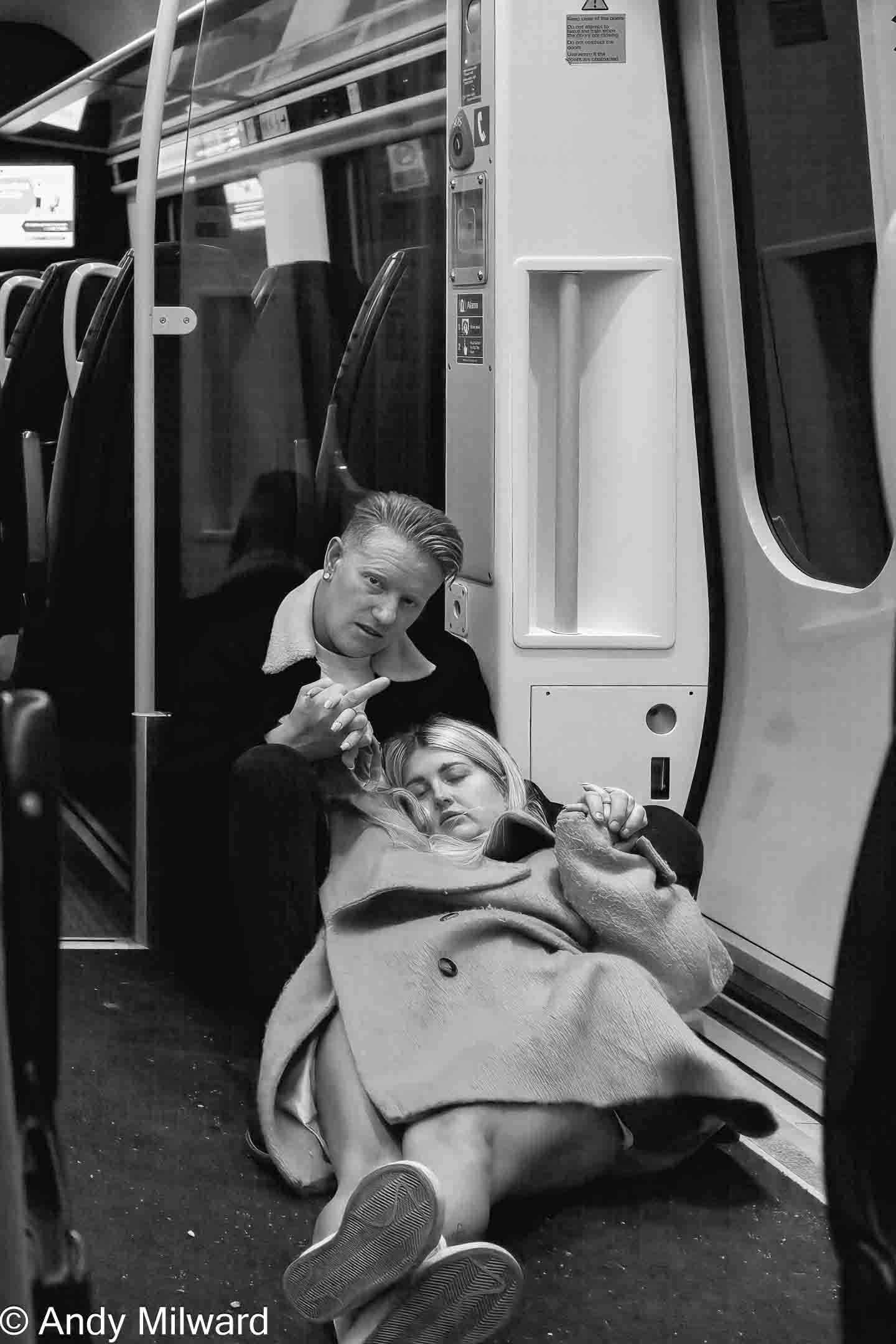
The last train home from Manchester City Centre on a Saturday evening is a social space that contains multiple social universes of friends and acquaintances who mostly share the characteristic of having spent an evening consuming food, alcohol, and often narcotics.
Most travellers are in the age range from late teens to early forties although the older generations feature as well.
I started to travel on this train when I first enjoyed nightlife in the 1970’s. Although I take this train infrequently now, it is much the same now as it was then, except that my experience of the journey has changed.
As an older person, in common with fellow travellers of my generation, I find the noisy, rowdy, profane and occasionally violent context uncomfortable.
As the train approached its penultimate stop, where I would disembark, I went to take a shot of a young man petting his lady friend who was drunk and lying on the floor.
As I positioned the camera, the man spotted me and ‘flipped me the bird’.
One may conclude that he found my behaviour intrusive. However, was he giving me the finger or was his abuse aimed at my generation?
Was I giving his generation the metaphorical finger in taking this shot?
The image has the potential to provoke questions such as, how do different generations see each other? Is there inter-generational tension, and if so why? Has this changed over the years, and if it has, why should this be?
The Lithuanian philosopher, Emmanuel Levinas (1906 – 1995), emphasised the idea of ‘the other’. A social community generates a shared social identity. Communities construct binary opposites, confronting other communities as somehow different.
The number of social psychological and philosophical questions that this image potentially prompt is endless.
The argument
Glasgow, in Scotland, has long held a reputation for being a city of contrast. The city is famed for its culture, architecture, intellectual heritage, wealth and specialty shopping.
However, Glasgow is also known for the Gorbals, a gritty area situated on the south side of the River Clyde, with a reputation for poverty, violence and other crimes.
Sometimes we do not have to visit a different area of a city to get a sense of what life is like there. I visited the fashionable Princes Square area of Glasgow to seek out images that contrasted the gritty with the refined.
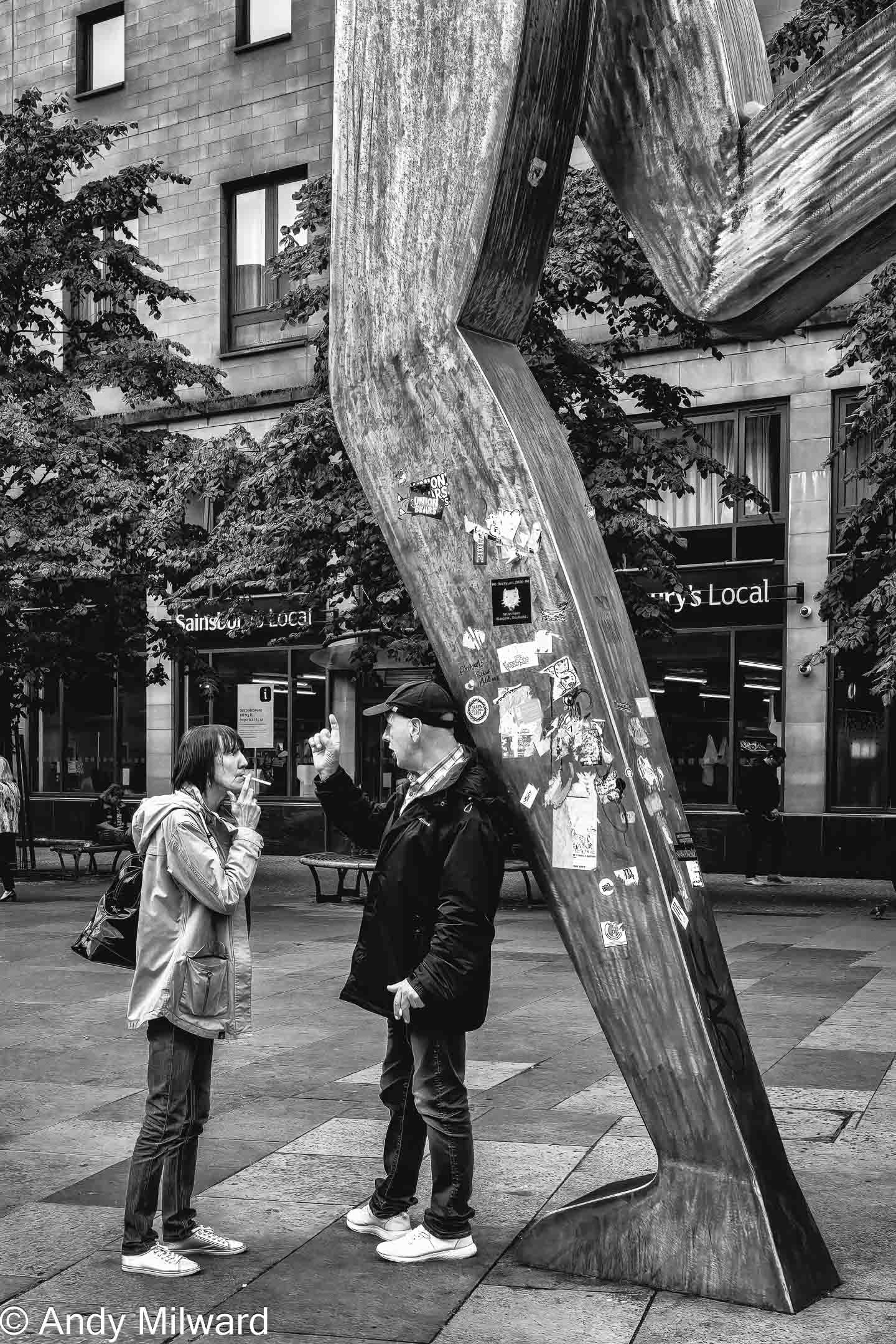
In this image, taken on Buchanan Street in the city centre, I encountered a couple locked in a heated argument. I felt their appearance and verbally violent behaviour gave me a glimpse of what I might expect to see in an underprivileged area of the city.
An interesting topic to research is how different socioeconomic groups are nested within one another or make incursions into one another’s territory.
It’s a good life
This image is also part of the set I took in Glasgow City Centre.
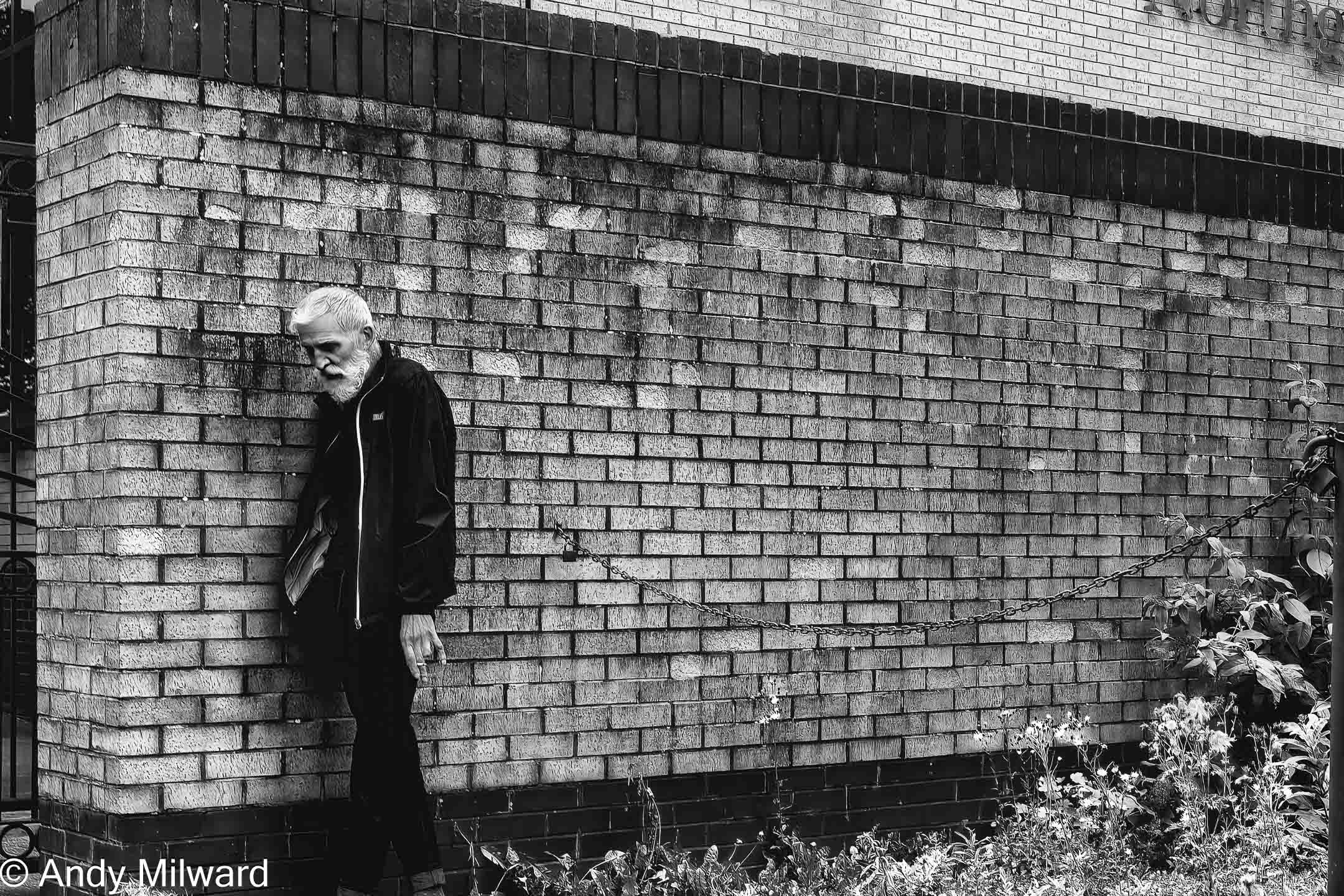
Dispute and depression contrast with the gentility and wealth in the swanky Princes Square area.
I have not included any of the contrasting images, but the collection gives an interesting insight into the two sides of a great city.
Does the coexistence of these characters with more privileged people in the city centre signal a lessening of the intense difference between the city’s two faces?
Is Glasgow now more unified albeit still geographically compartmentalised? If so, why?
Is the image a metaphor for a more unified society overall?
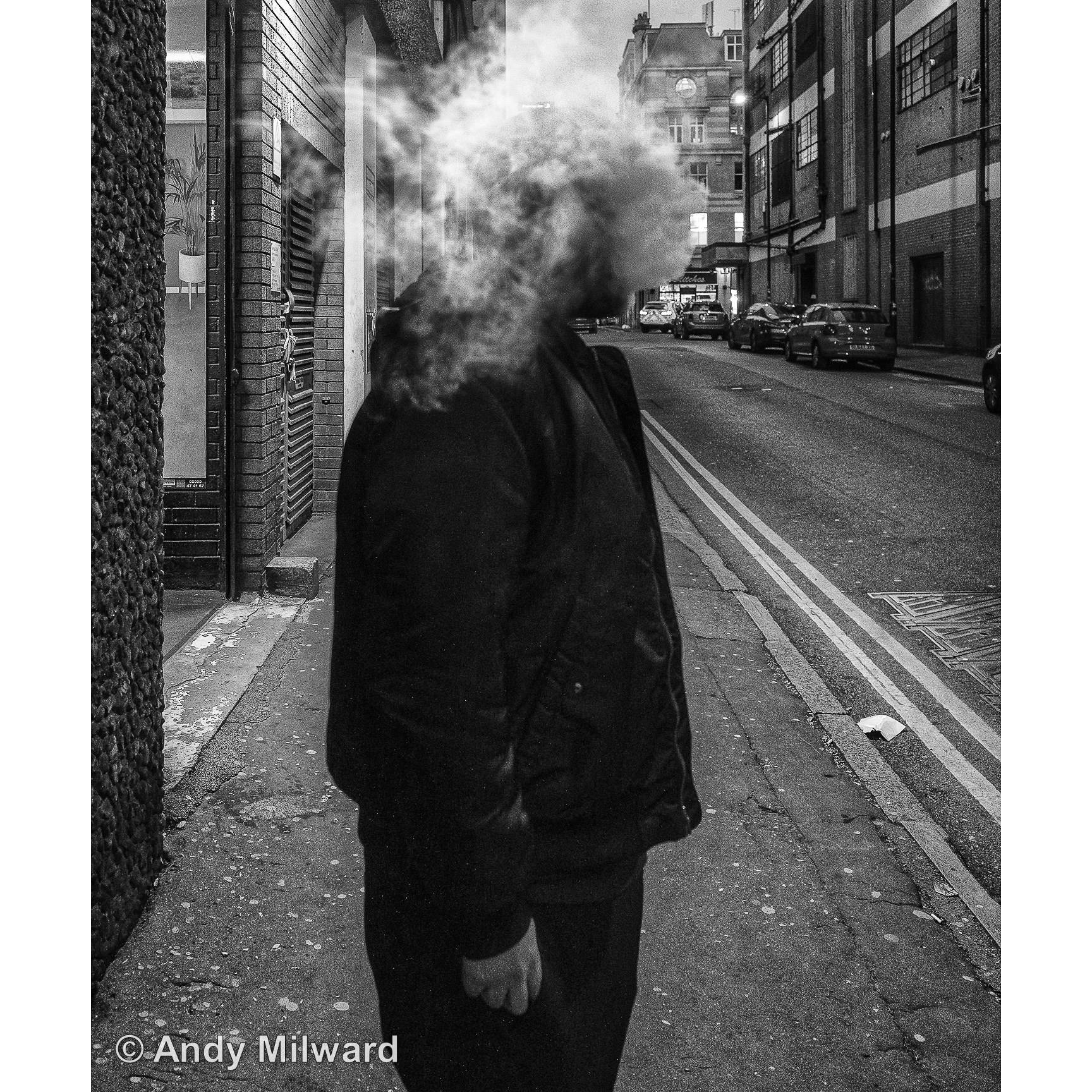
Spontaneous human combustion
Humour is a useful technique in photography as it captures attention and entertains.
Vaping is a ubiquitous feature of contemporary life.
This image illustrates how people’s behaviours in pursuit of personal autonomy generate rule systems that constrain them.
I recall when people routinely smoked in the close presence of non-smokers, much to the ire of the latter.
It is now highly unusual for a smoker to impose the secondary effects of their habit on others. Buildings have been smoke-free zones for decades, and smokers have formed social smoking clusters. We see them in small groups outside office buildings.
Social groups have developed norms that render smoking in the presence of non-smokers socially unacceptable.
It is anathema for a smoker to smoke when in the company of their non-smoking friends and colleagues.
Smoking is a social activity. Friends, colleagues and strangers are united through their habits. They enjoy the company of the small group of fellow smokers who gather outside during work breaks.
Attachment to their group, therefore, maintains their habit and their habit facilitates their interaction with strangers who smoke.
Ambivalence is often the greatest challenge when helping someone to change their behaviour.
Smokers think they will lose an important part of their social lives if they can no longer smoke with fellow smokers. This is a pressure that maintains their habit. They do not see a value in stopping smoking that outweighs the benefits of smoking.
The only way to resolve this ambivalence is for a third person to help the smoker (or other addicts) recognise that their habit’s negative effects massively outweigh the social benefits they believe they gain.
However, vaping is perhaps a more benign habit that does not trouble non-vapers/non-smokers as much.
Maybe vaping is a successful strategy to help people stop smoking because it does not challenge social unity.
Life through a windscreen: the scratch
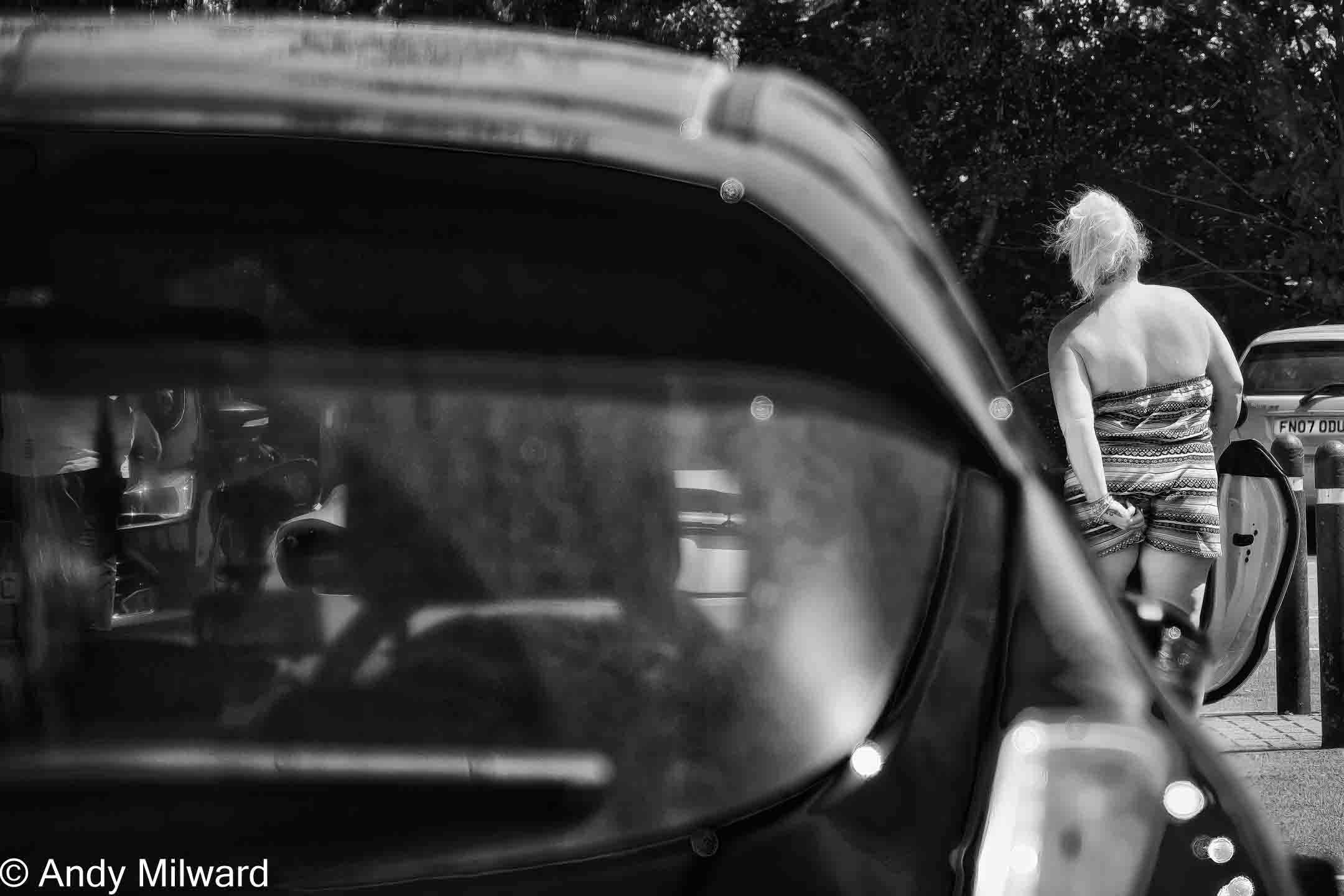
Street photography requires us to look keenly for opportunities to take images.
In this image, I illustrate how I expanded the opportunities for interesting shots by taking photos from a perspective that had never occurred to me before.
Sitting in a stationary vehicle in a car park, I listen to the radio, scroll on my phone, read a book or even sleep. It had never occurred to me to use that period in the car to observe life outside the car through the windscreen.
My windscreen is invariably dusty or spattered with raindrops. I have always thought that would spoil an image.
But I have realised that by embracing the windscreen, I can take shots that are stripped further of immediacy, just as conversion to black and white removes the distraction of colour, pushing the image back to emphasise the pure concept.
The architecture of the windscreen and the juxtaposition of other vehicles, artefacts and structures provides creative framing opportunities.
The shot has an element of humour that most people can relate to.
Hands
In Martin Luther King’s famous speech on August 28th 1963 Washington DC, he said, “I have a dream that my four little children will one day live in a nation where they will not be judged by the colour of their skin”, …this engages the audience who think, well, how will they be judged?
King employed a classical rhetorical technique, a puzzle-resolution structure, to capture the audience’s attention and render his speech memorable.
Posing a puzzle in a speech invites the audience to work out what the puzzle part means. This focusses the audience as they try to find the solution. They may also feel complimented that the speaker respects their capacity to work out the answer for themselves which tends to embed the meaning of the solution in their minds.
Martin Luther King then answers the question by adding the phrase, “but by the content of their character.”
The connection between the puzzle and resolution element is salient in its social context, a huge gathering of oppressed black citizens.
Consciously or not, many photographers exploit this oratorical technique.
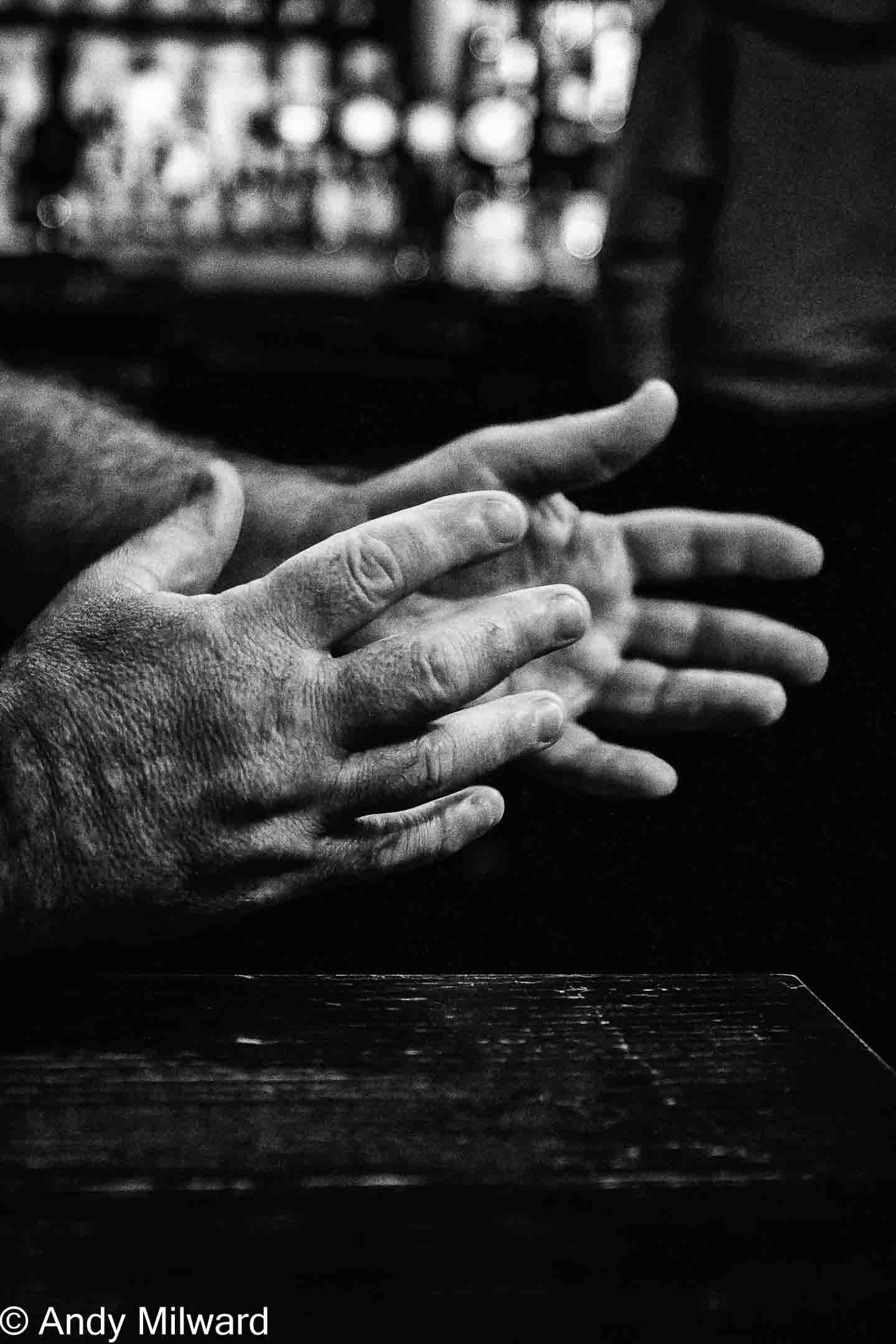
In this image, I focused on a man’s hands over a table as he engaged in a lively conversation with others in a bar.
The image poses the question, why the emphasis on the hands?
I intended to lead the viewer on a journey from the tip of the man’s left thumb through the standing individual into the bar, both of which are rendered in bokeh.
Pubs and bars are urban structures designed to facilitate conversation, one example of how humans generate physical structures to support the quest for agency.
Each bar contains multiple social clusters suspended in the space of the bar.
Bars are therefore microcosmic social hubs where we can observe the ebb and flow of social structuration in action.
The connossieur
Wine has contributed to the shaping of society since 6000 BC.
Used in religious, civil and other ceremonies, rites and celebrations, wine is embedded in our lives.
Good wine serves as a social status symbol, and as with other forms of alcohol lubricates social interaction.
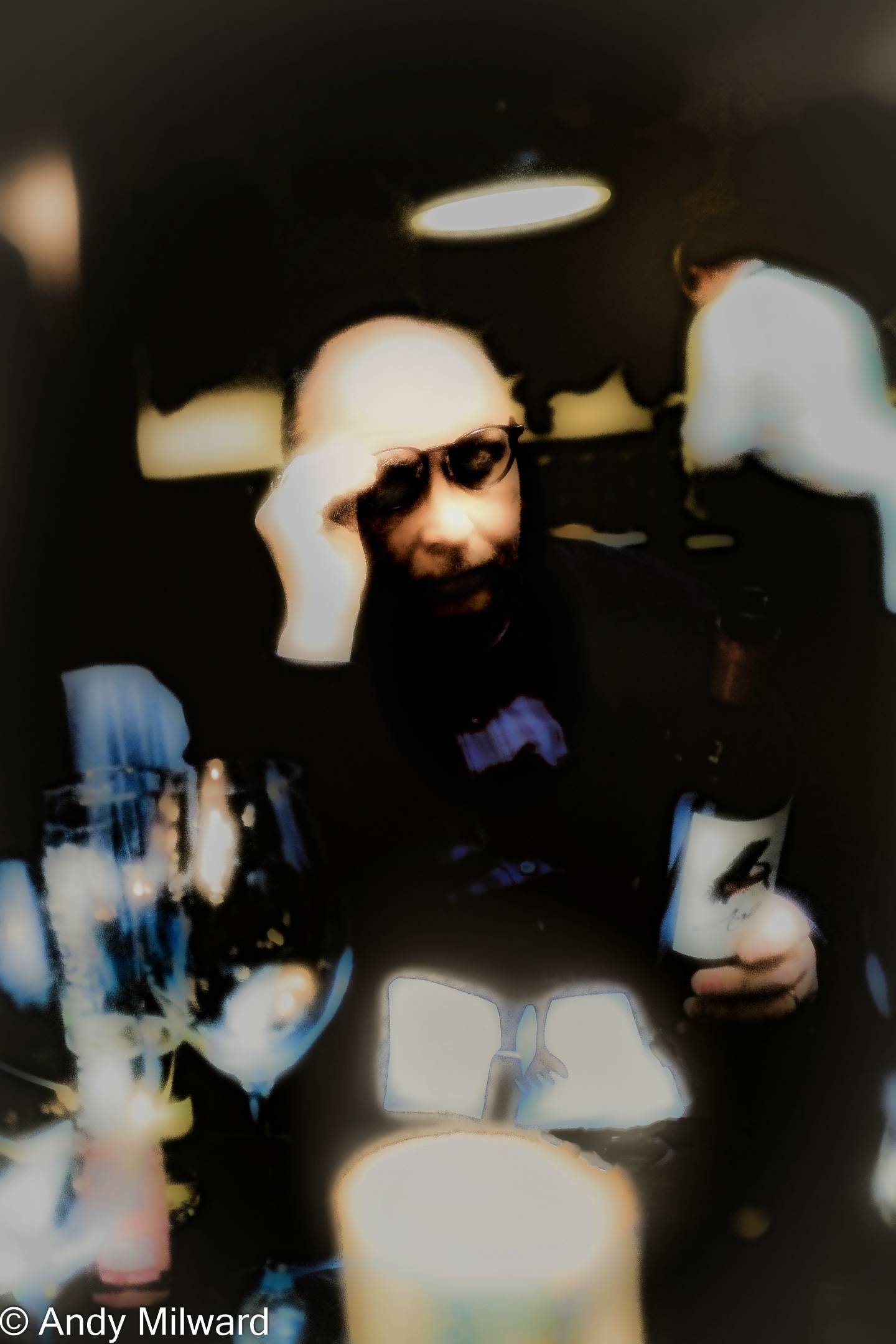
In this image I wanted to capture wine consumption in a fine dining context to stimulate questions about its social significance.
I chose to use defocus to create an impressionist-style image that represents the dreamlike quality of our memories of special occasions.
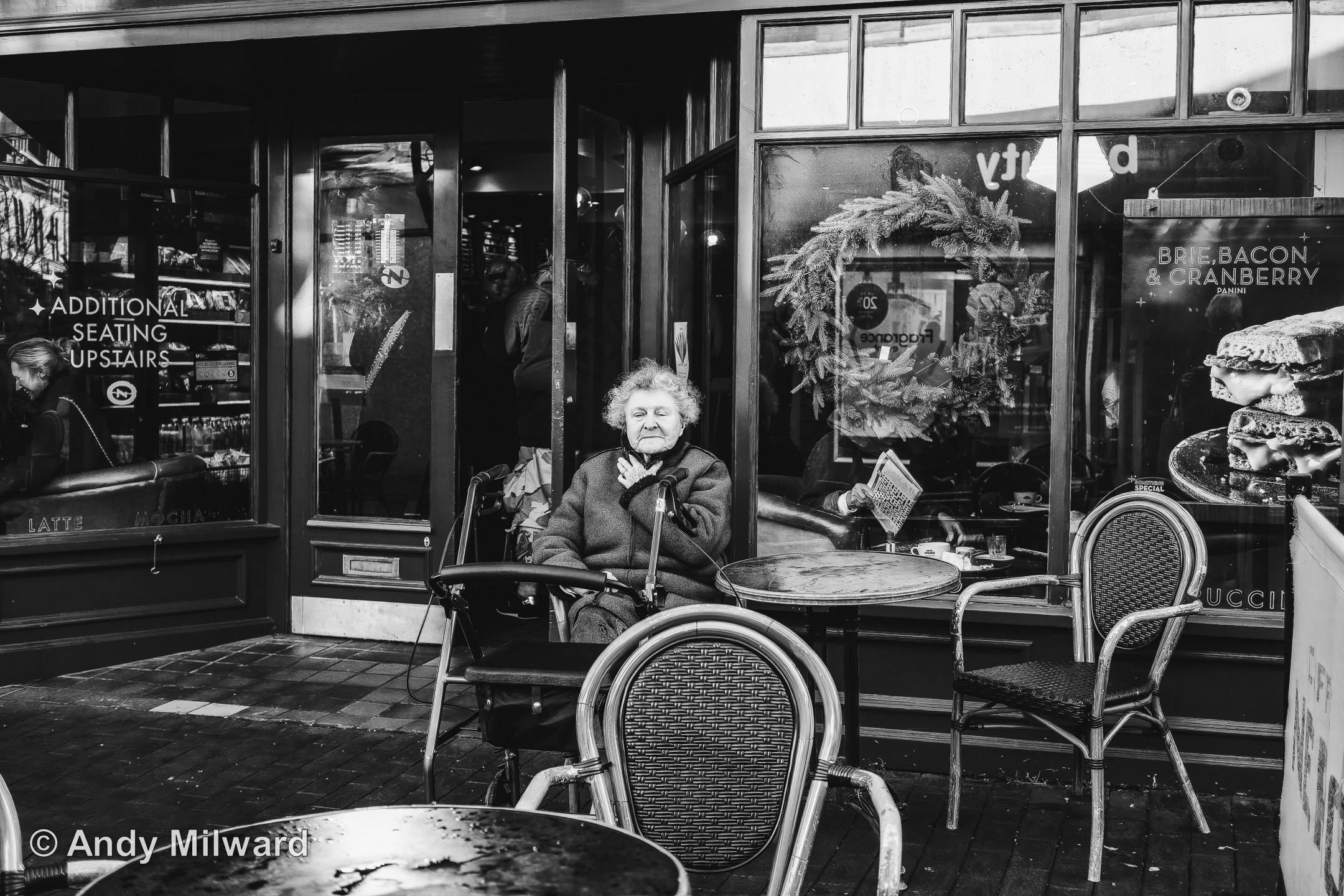
Additional seating upstairs
It was Christmas Eve. The rain was pouring and it was very cold in the swanky shopping area in Wilmslow, Cheshire, one of the most affluent towns in the UK.
I spotted this elderly disabled lady sitting outside Café Nero, eyes closed and holding her coat together as if to keep out the cold.
The café was bursting with younger people who, perhaps, had chosen to shelter from the rain and have a coffee and snack before resuming their last minute shopping.
The elderly lady looked very uncomfortable, a forlorn figure contrasting with the vibrant society inside the café.
This scene illustrates numerous aspects of social structure.
The elderly, the disabled and those who are both, may struggle to integrate with younger, able bodied people in certain contexts.
The boundaries of social clusters are less permeable to such people because they exhibit characteristics that make their full participation in the life of a cluster hard or impossible.
Flautery
Street music has been embedded in culture across the world for millenia.
Wherever people go about their business and socialise in public places, street musicians are a staple that entertain us.
The study of street music through photography can help us understand the perspective of diasporic and migrant people as many are from overseas.
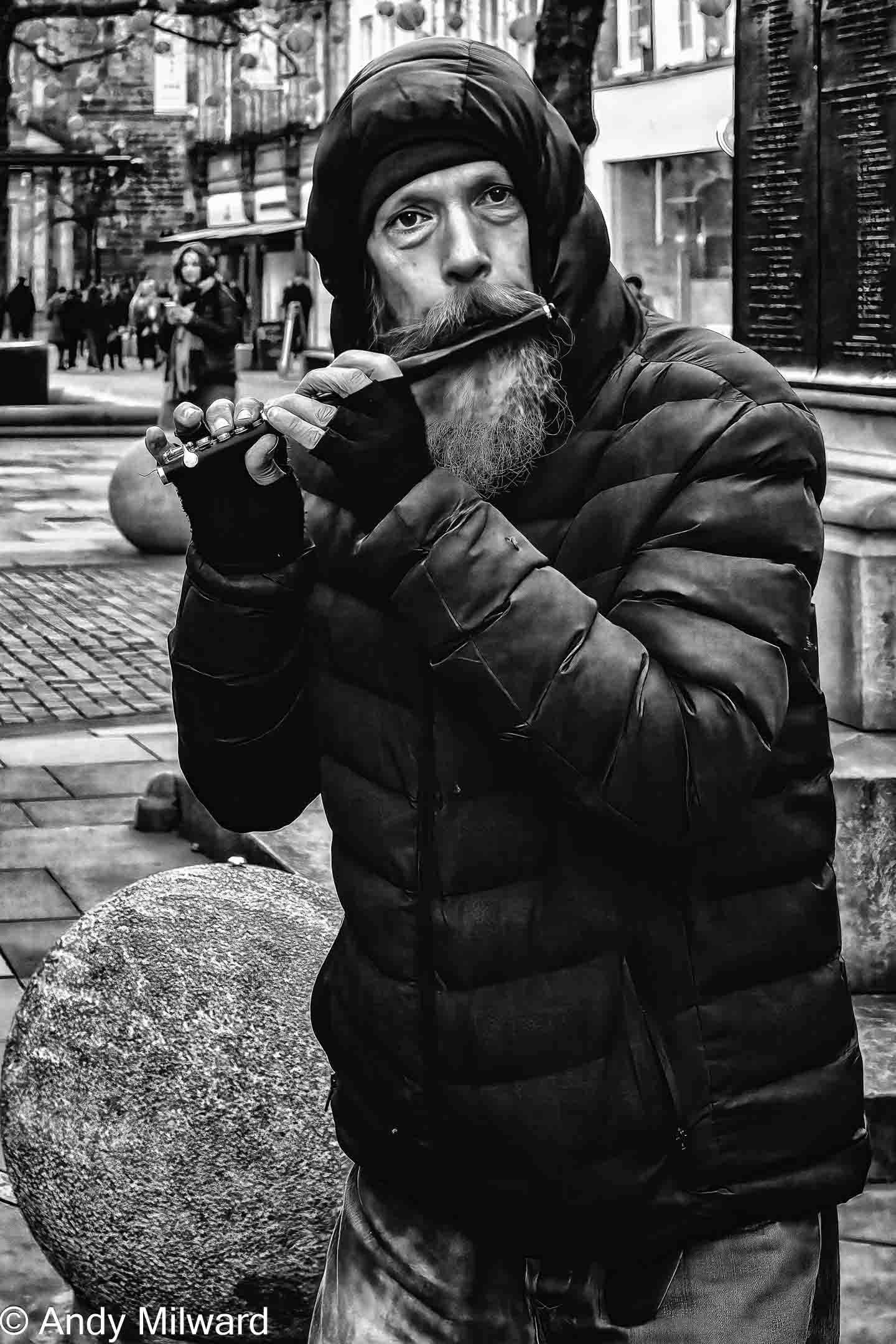
This gentleman is a feature of life in the expensive St Anne’s square district in Manchester City Centre.
I asked him if I could take his portrait with the intention of engaging him in conversation.
I learned that his name is Jim, he is a very talented flautist and a long-term immigrant from Sweden, a country that I lived in for several years, which laid the foundation for friendship between us.
We often speak to each other when I am in the city centre.
Strangely, on another occasion, in a different town, I took an urban portrait of an individual (not a street musician), called Dave, who bore a striking resemblance to Jim.
Dave was similarly hirsute, dressed like Jim, and very approachable.
Dave told me that he knew Jim, who had approached him for a cigarette in central Manchester some months before.
I found this an interesting illustration of how a person’s choice of appearance signifying membership of a particular category, fosters interaction, friendship and the formation of new social clusters.
The big issue
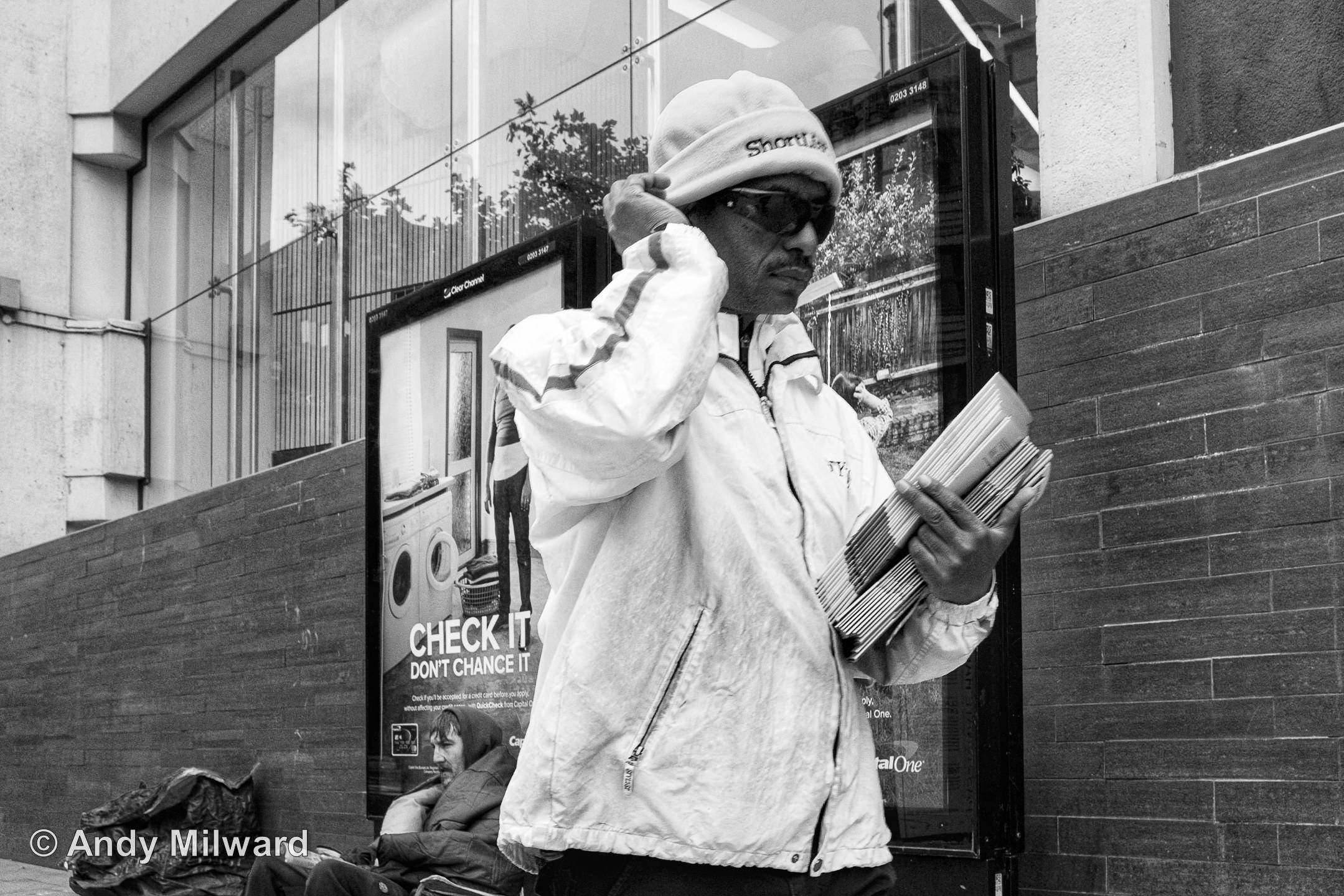
This shot is a coincidence of two people, one seriously disadvantaged and beaten by the system and another, probably similarly disadvantaged, working to relieve their common plight.
The homeless person is serendipitously juxtaposed with the man selling the ‘Big Issue’ magazine.
Paradoxically, to the extent that some may argue homeless people are casualties of a capitalist system, the image shows how entrepreneurship in the charity sector can help to emancipate the disadvantaged.
I took this shot from the hip as it would have been an impossible capture otherwise.
Black and white
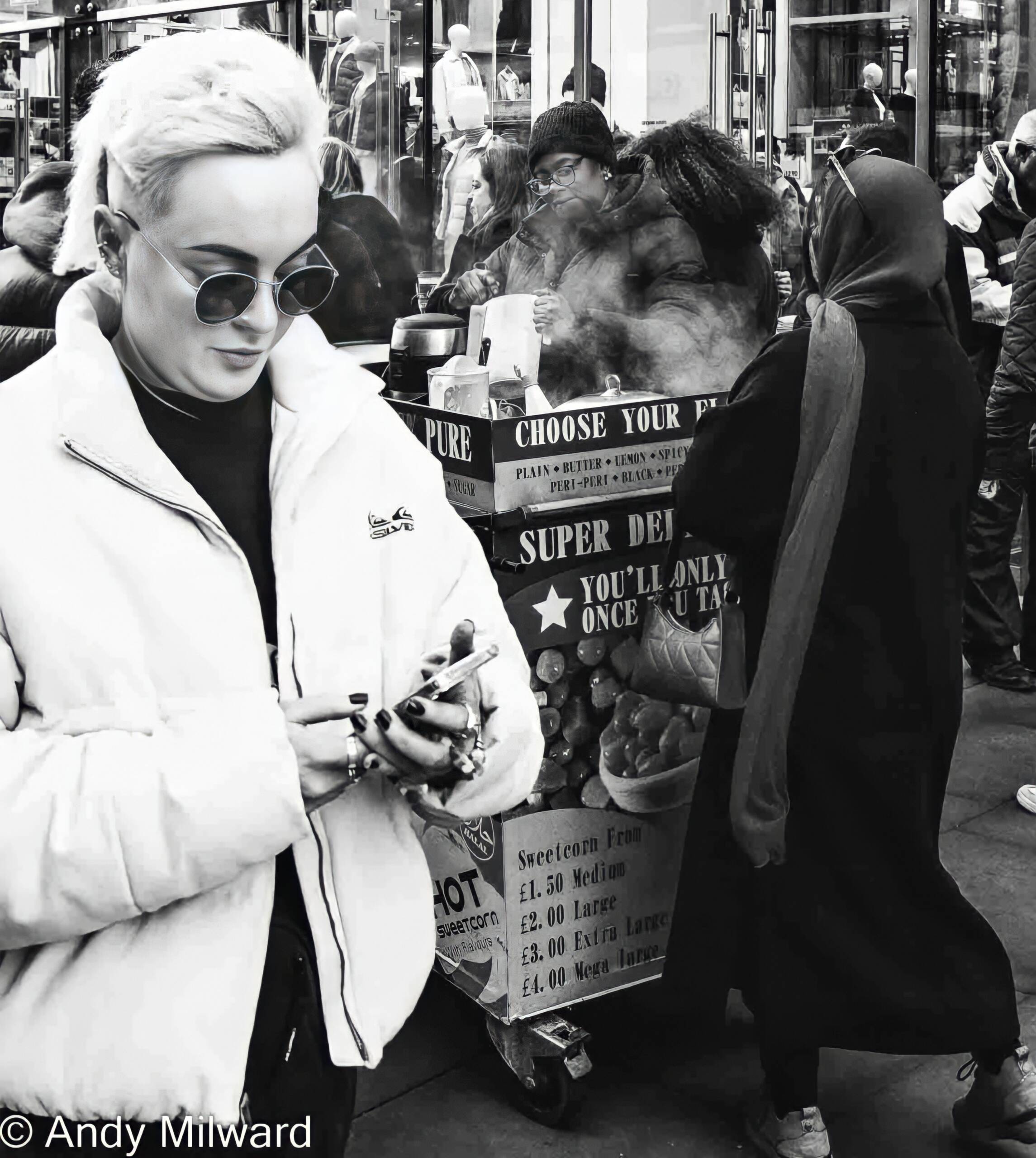
A recurrent theme in the images I have included is the idea that social groups develop their own identities that are in binary opposition to other groups.
This image draws attention to the binary differences between religious denominations, the secular and, ethnic groups..
The image features a white millennial girl juxtaposed with an Asian Muslim woman, visually connected through a street kitchen run by a woman of apparent black African origin.
The white girl and the African woman are facing in different directions. This metaphorically emphasises the differences between them.
Yet each woman is wearing dark sunglasses. Perhaps this suggests all people under the sun are fundamentally the same.
All people are connected by their need for food, as the positioning of the street kitchen between the women suggests.
There is no negative tension in the image, just shared acceptance of the presence of differences in the same social space.
As social documentary, I think the image highlights peace and tolerance of others who are different.
Manchester has a reputation as one of the most liberal, friendly cities in the UK.
In recent years, this liberalism has been encapsulated in the ‘One Love’ theme.
This is the name of a benefit concert that the American singer Ariane Grande organised in the city in 2017 to celebrate the lives lost and those irreparably damaged by the terrorist bombing of Manchester Arena at her performance there two weeks earlier.
The concert symbolised the strength, defiance and love that unites the people of Manchester.
The source of these attributes is a fascinating topic for documentary study through audio-visual media as well as street and documentary photography.
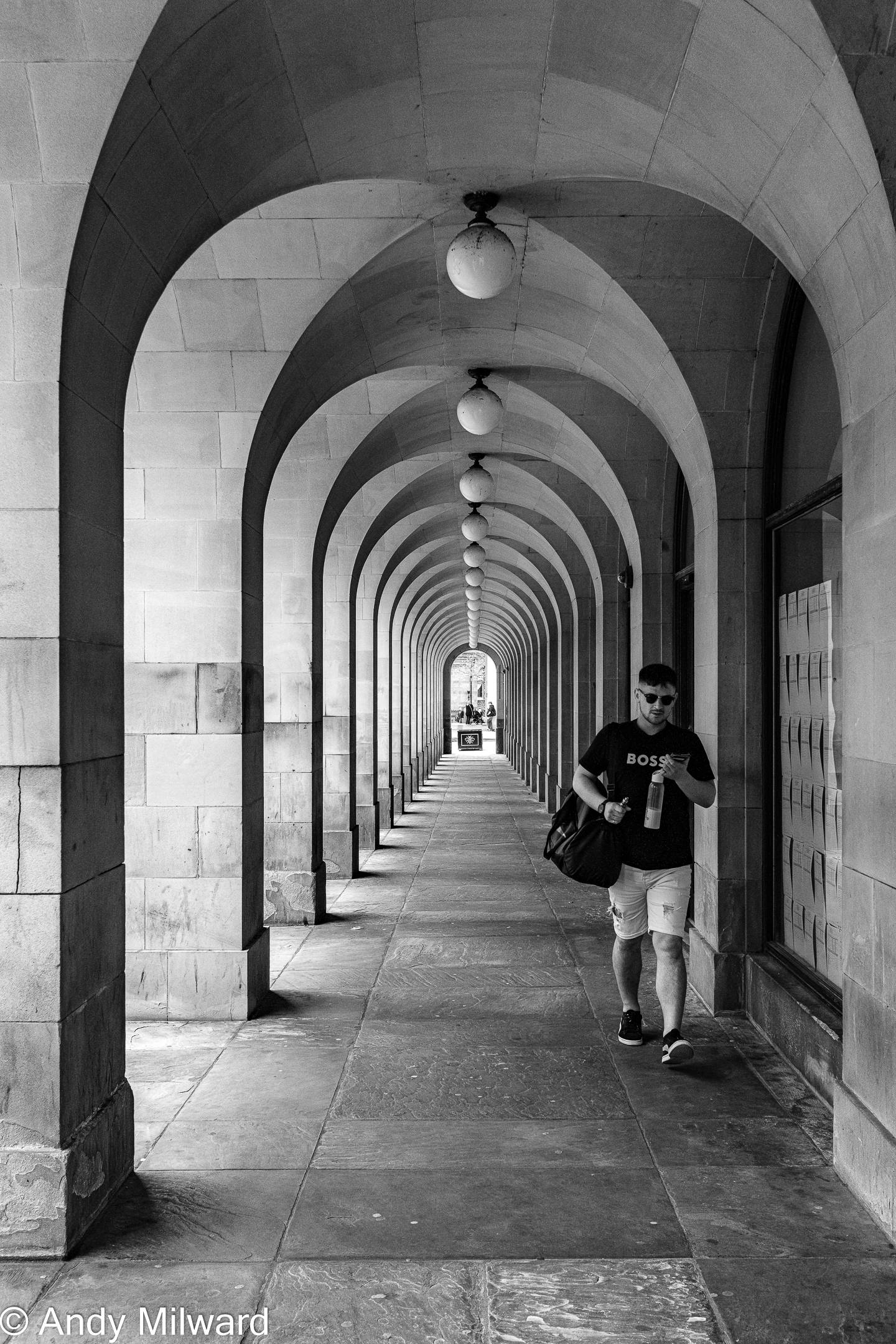
Rhys
The majestic central lending library arches in Manchester’s St Peter’s Square is a popular venue for photographers.
As I lined up my camera to capture the beautiful geometry of the arches a man entered the frame. He gestured that he would move away so he did not spoil my field of view. However, I beckoned to him to continue.
I felt his position in the frame was visually very satisfying.
I showed him the image and he asked if he could share it on social media. Of course I agreed.
His name was Rhys and he lives with his partner Rick.
Prompted by this image we decided to arrange a photoshoot together that would celebrate the diversity and tolerance of Manchester.
We plan to hold our shoot in the Canal Street Gay sector shortly.
Photography can bring people together.
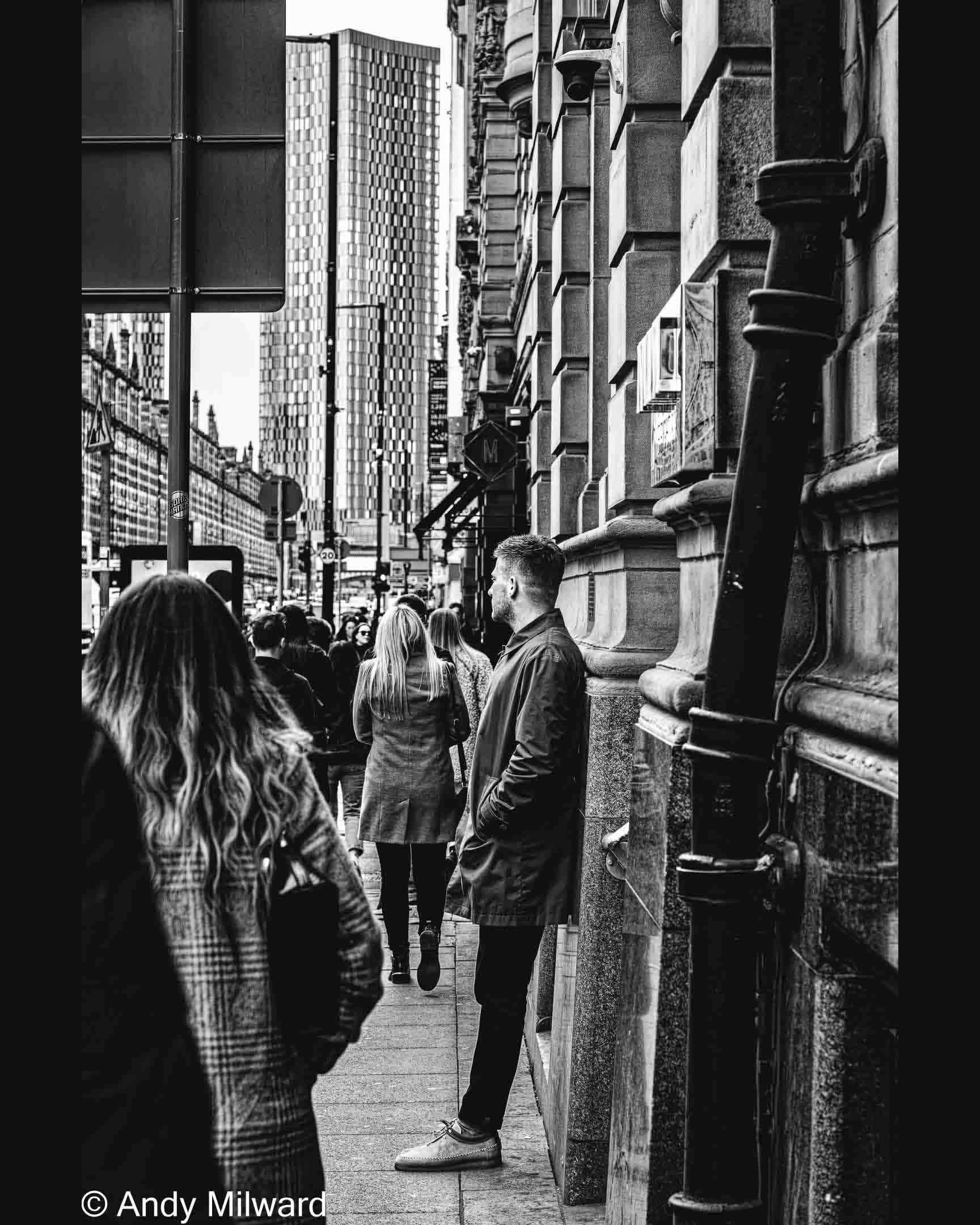
Suspicious character
I took this shot on Deansgate, a major street that runs across the centre of Manchester.
Having walked a lot, I paused a while. As I rested I noticed a man leaning against the wall of an office building. He was looking from side to side continually. His behaviour intrigued me as it seemed incongruous in the context of the bustle of the street.
I observed the man for over one hour. He continued to lean against the wall looking from left to right, scanning the people passing by.
Was he waiting for someone? Or, was he looking for someone?
The scene reminded me of the threat that terrorists and criminals pose to all social communities and the risks that those who try to protect us have to take from inside those groups.
I do not, and do not want to know whether he was an undercover police officer or a secret service operative.
I am just glad he was there.
The presence of absence
With this final image, I revisit some of the material I set out in the introduction and consider how photography can contribute to philosophical analysis.
Social Psychology defined
The Social Psychologist Gordon Allport defined Social Psychology as “the scientific attempt to understand and explain how the thoughts, feelings, and behaviour of individuals are influenced by the actual, imagined, or implied presence of others” (Allport, 1954).
Although the words ‘imagined’ and ‘implied’ point to people who are not present, the focal party thinks that others are present, and the question is, what effect does their belief in the presence of others have on their behaviour? The idea is that the belief of presence has the same causal status as actual presence.
However, I suggest we can add to Allport’s definition the absence of people.
The new definition is therefore:
“Social Psychology is the scientific attempt to understand and explain how the thoughts, feelings, and behaviours of individuals are influenced by the actual, imagined, or implied presence of others,” and the [absence of persons who may at times be present.]
To understand why I suggest including this element we must consider the philosophical works of the philosopher the late Jacques Derrida (1930 – 2004).
Jacques Derrida and the presence of absence
Derrida developed the idea that the state of actual absence has the ontological status of a form of presence.
In philosophy, Ontology is the study of what we can take to be real.
A phenomenon is real in a philosophical sense if it has the capacity to affect something else.
From Derrida’s perspective, the absence of something has causal properties; it can affect the behaviour of those who observe it and ontologically, therefore, it is real, it exists, it is accordingly present.
Something does not need to have a tangible form to constitute an aspect of reality.
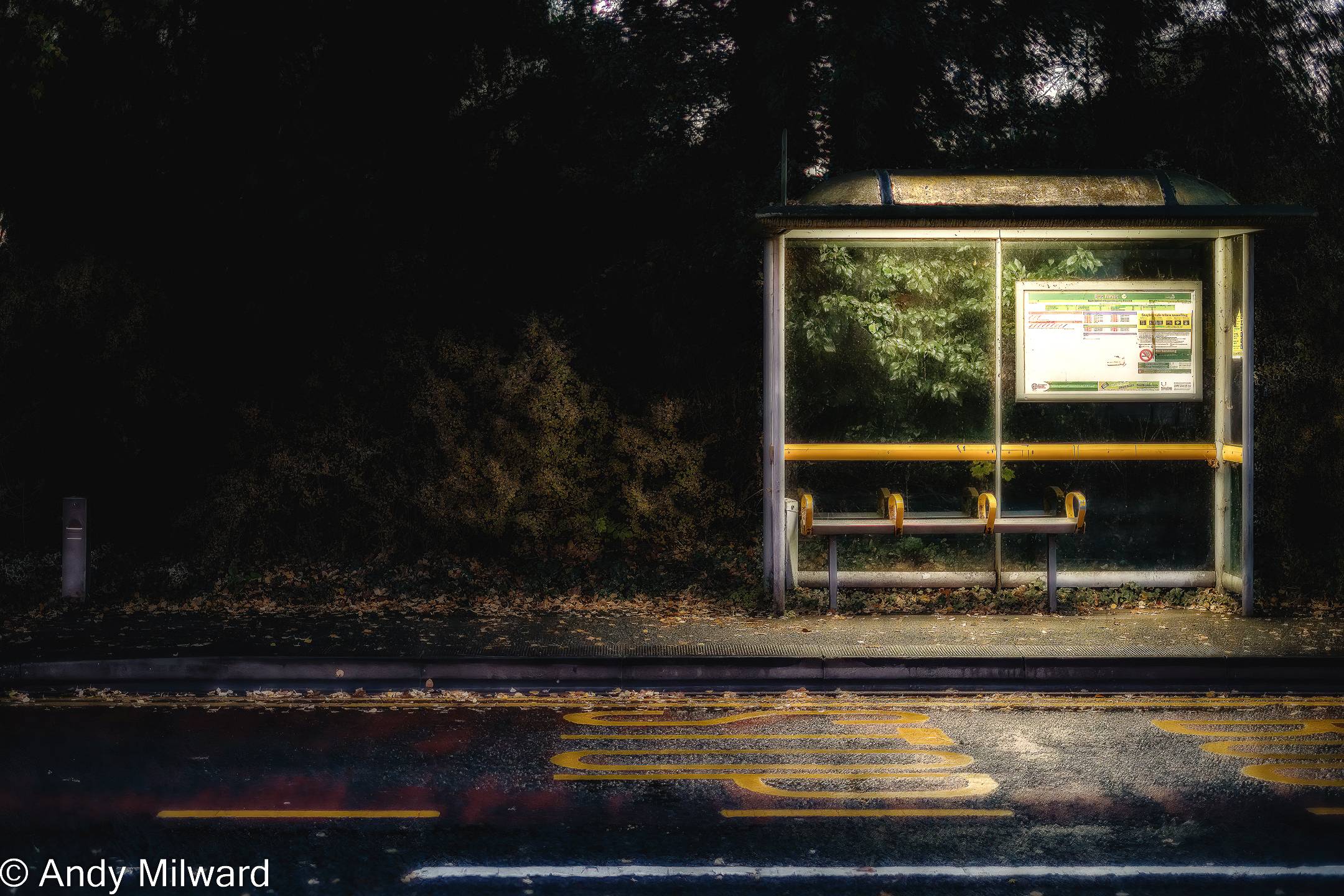
The above image, a prosaic example, but pedagogically useful, features an empty bus shelter.
Bus shelters are populated with people at times and empty sometimes.
With this image, I tried to explore this idea that the emptiness of this shelter has the ontological status of a presence.
The emptiness is a void that has the capacity to provide cover for people queuing for a bus. The absence therefore may influence how people think, feel and behave. The emptiness therefore possesses causal properties.
Norms
The bus shelter image is also a comment on the tension between Agency and Structure. As people pursue agency, they generate rules, formal and informal, that structure their behaviour.
In the UK and many other parts of the world, we observe the social norm of queueing.
Queuing is an informal rule that exerts a subliminal influence on people. There is no legal precedent or legislation that dictates that we should queue. Forming a queue is a normative solution to a problem that has emerged from the pursuit of agency, the need to allocate goods and services efficiently whilst respecting a community’s shared sense of fairness (who should come first) .
We do not reflect on why we are queuing, although we react when we find someone infringing the norm
Pedagogy
I have successfully used this image to stimulate discussions about the nature of reality and the causal rule structures that we generate as we pursue human agency.
Photography is a useful method for philosophical analysis.